Sorry that these posts have been so few and far between, but its been a bit crazy as of late. School just started up again and so its been a bit hectic, but if you'll just bear with me I'll start posting more and eventually try to get up to 4or 5 posts a month, about one a week is what I'm hoping for.
In the meantime, my Cineastes review for this month is coming up here in a bit (Au Revoir Les Enfants, sorry its late too), so please check that out. Thanks for reading!
Saturday, August 22, 2009

Tuesday, July 21, 2009
The Best Films of 2009 (So Far...)
I obviously haven't been able to catch every flick released thus far this year, but I have seen most of the major ones. Here are my five favorites, in ABC order:
Bruno
 Sacha Baron Cohen's controversial follow-up to Borat is even funnier and more subversive than its predecessor.
Drag Me To Hell
 Everything you've heard about this movie is true. Drag Me To Hell is a return to form for Sam Raimi; it's funny, scary, and a helluva lot of fun.
Knowing
 Wrongfully bashed upon its release, Knowing is smart, dark, and boasts a few awe-inspiring F/X moments. It just came out on DVD, so you don't have a reason to avoid it anymore.
Two Lovers
 James Gray (We Own the Night) has crafted a romantic, heart-breaking masterpiece with Two Lovers. Joaquin Phoenix has stated that this will be his last film. Let's hope not, though, because he gives a great performance here as a suicidal man caught in a love triangle with Gwyneth Paltrow and Vanessa Shaw.
Watchmen
 Watchmen is one of the darkest superhero films I've seen. It's big and explosive, sure, but underneath all that it's unrelentingly bleak and intelligent. You can read my review of it elsewhere on this blog.
It's been a strong year for films so far. Let's hope it keeps up and surpasses last year's weak showing.
Bruno
 Sacha Baron Cohen's controversial follow-up to Borat is even funnier and more subversive than its predecessor.
Drag Me To Hell
 Everything you've heard about this movie is true. Drag Me To Hell is a return to form for Sam Raimi; it's funny, scary, and a helluva lot of fun.
Knowing
 Wrongfully bashed upon its release, Knowing is smart, dark, and boasts a few awe-inspiring F/X moments. It just came out on DVD, so you don't have a reason to avoid it anymore.
Two Lovers
 James Gray (We Own the Night) has crafted a romantic, heart-breaking masterpiece with Two Lovers. Joaquin Phoenix has stated that this will be his last film. Let's hope not, though, because he gives a great performance here as a suicidal man caught in a love triangle with Gwyneth Paltrow and Vanessa Shaw.
Watchmen
 Watchmen is one of the darkest superhero films I've seen. It's big and explosive, sure, but underneath all that it's unrelentingly bleak and intelligent. You can read my review of it elsewhere on this blog.
It's been a strong year for films so far. Let's hope it keeps up and surpasses last year's weak showing.
Monday, July 13, 2009
Big Trouble In Little China

I was quite pleased to hear that The Cineastes would be reviewing Big Trouble In Little China this month. Not because I had seen it before, because I hadn't. The movie had been on my queue for a while, though. I was happy to review the film because I knew I would like it. I'm a sucker for cheesey, dumb, corny 80's flicks, and this one seemed to have it all.
Kurt Russell stars as Jack Burton, a truck driver caught in the middle of 2,000-year old Chinese black-magic sorcerer's plan to kidnap and marry a girl with green eyes so he can become young again. That girl just so happens to be Jack's buddy's fiancee. So Jack and his friend, along with the lovely Kim Cattrall as lawyer Gracie Law (because why wouldn't that be her name) set out to rescue her.
This leads them to an underground world of ancient Chinese mysticism and monsters. They fight street gangs, wizards, demonic creatures, etc. The point of the film is fun, and Big Trouble succeeds. From the corny dialogue to the B-movie set pieces to the cheesey plot and characters, everything about the film is a barrel of monkeys.Kurt Russell is perfectly over-the-top as Jack Burton. Almost every line he utters is eminently quotable in its cheesiness.
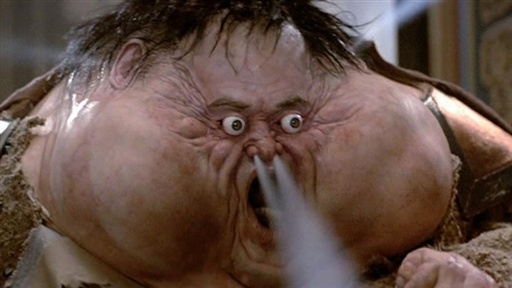
Unfortunatly, though, the film is sometimes too dumb. Unlike some of director John Carpenter's other movies, Big Trouble In Little China doesn't really have any social value. They Live was about the economy at that time. Halloween was about young sexuality. Big Trouble is about...ancient Chinese secrets. The film exists for the purpose of having a good time at the theater.
And there's nothing wrong with that. You just probably won't remember much about it in a few weeks. But that's ok. Enjoy it while it lasts.
BIG TROUBLE IN LITTLE CHINA : B
This month's CINEASTES review has been hosted by Crap Monster at YGG'noise (http://www.yggnoise.com/)
Saturday, June 27, 2009
Che
Last year, one of my most anticipated films was Steven Soderbergh's Che. Being a fan of Soderbergh, I was very interested in seeing what he would do with a biopic. Would he make it unconventional, and turn it in to one of his "stranger" indie flicks (Schizopolis, Bubble)? Or would he turn in a normal film and go for a large distribution (the Ocean's series, although none of his films are really "traditional.")
Considering Che's length (the film clocks in at around 4 hours) the latter seemed somewhat impossible, and the film's audience was shifted to the arthouse when it was picked up by IFC, one of the few distributors with any balls out there (it was, after all, the only one to consider Lars von Trier's Antichrist.)
 But now that the film is on DVD, anyone can see it, not just those living in New York or LA. Che lands somewhere in the middle of Soderbergh's "weird" and "normal" films. It's the best film thus far to be made about Che Guavara. The first part of the film, The Argentine, shifts between Che's and Fidel Castro's Cuban revolution and their brief time in America. Part two, Guerilla, documents Che's involvement in the Bolivian Revolution. Both parts are essential to each other, and should be watched and considered as a whole, not two separate films.
Benicio del Toro had some early Oscar buzz for his portrayal of the revolutionary. He's magnificent in the title role, the rare performance that fully embodies such a well-known and polarizing figure. His performance, as well as Soderbergh's direction, are not biased in or out of favor with the man. The film remains neutral, unlike the living Che-boner The Motorcycle Diaries (which is actually a really good film.)
Unfortunately, del Toro's performance went unnoticed by the Academy when Che shot completely under the radar. If you've got 4 hours to spend, give Che a watch. But if not, at least check out The Girlfriend Experience. If you live in New York or LA, that is...
CHE : A-
Considering Che's length (the film clocks in at around 4 hours) the latter seemed somewhat impossible, and the film's audience was shifted to the arthouse when it was picked up by IFC, one of the few distributors with any balls out there (it was, after all, the only one to consider Lars von Trier's Antichrist.)
 But now that the film is on DVD, anyone can see it, not just those living in New York or LA. Che lands somewhere in the middle of Soderbergh's "weird" and "normal" films. It's the best film thus far to be made about Che Guavara. The first part of the film, The Argentine, shifts between Che's and Fidel Castro's Cuban revolution and their brief time in America. Part two, Guerilla, documents Che's involvement in the Bolivian Revolution. Both parts are essential to each other, and should be watched and considered as a whole, not two separate films.
 Benicio del Toro had some early Oscar buzz for his portrayal of the revolutionary. He's magnificent in the title role, the rare performance that fully embodies such a well-known and polarizing figure. His performance, as well as Soderbergh's direction, are not biased in or out of favor with the man. The film remains neutral, unlike the living Che-boner The Motorcycle Diaries (which is actually a really good film.)
Unfortunately, del Toro's performance went unnoticed by the Academy when Che shot completely under the radar. If you've got 4 hours to spend, give Che a watch. But if not, at least check out The Girlfriend Experience. If you live in New York or LA, that is...
CHE : A-
Sunday, June 14, 2009
The Gambler

"You're crazy!" says Axel Freed's girlfriend in one scene of The Gambler. "But I'm blessed," he responds. He is about to make a risky move in a high stakes game of blackjack. The tension builds. Sweat drips down Freed's brow. The dealer lays down the card and... 21. A lucky draw, something Freed isn't used to.
It's this attitude of needing risks to feel alive that has Axel Freed in over his head in debt, $44,000 to be exact. If he can't come up with the money soon, the dangerous loan sharks he's gotten himself entangled with might kill him, or worse go after his family.
James Caan plays Axel Freed, a troubled teacher and gambling addict in Karel Reisz's 1974 drama The Gambler. Caan appears in every scene, every frame almost, of the film. His performance is amazing and made even more so considering the fact that Caan was battling a cocaine addiction during shooting.
The film was one of the many forgotten gems of the New Hollywood era. Soon after the Hayes Code was dissolved, American filmgoers were eager for more raw films with tougher subject matter than they were used to. Films like Easy rider and Bonnie & Clyde satisfied their thirst, while many films, The Gambler included, got pushed aside in the process.
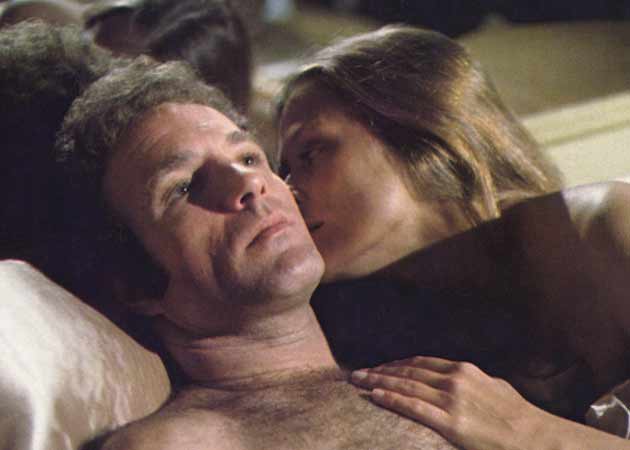
Karel Reisz, who also directed The French Lieutenant's Wife and the excellent Saturday Night and Sunday Morning, keeps a steady eye on Axel Freed. The film is dark and gritty, yet entertaining, and Caan's performance is eminently watchable.
The Gambler is a character study above all else. The battle against gambling Axel Freed deals with on-screen is mirrored by Caan's off-screen personal demons. Another sad case of art imitating life.
The fake character, however, doesn't really want to give up gambling. Although he acknowledges that it's a problem, he loves the risk. He only truly feels alive when his livlihood is at stake. He's not in it for the game. In his eyes, everything in life is a game. He gambles for the rush of it, just to feel something. He's willing to take the risk to get that rush, unfortunatly hurting everyone around him and the ones he loves in the process.
THE GAMBLER : A-
This month's CINEASTES review has been hosted by Josh Wiebe at Octopus Cinema (http://octopuscinema.blogspot.com/)
Monday, June 8, 2009
Wendy & Lucy

Wendy and Lucy is American neo-realist filmmaker Kelly Reichardt’s latest addition to the movement, and her follow up to the acclaimed Old Joy. Wendy and Lucy stars Michelle Williams as Wendy Carroll, a young woman traveling to Alaska in search of work. Her only companion is her dog Lucy. Wendy faces challenges along the way (lack of money, broken car, etc.), but the worst of her setbacks is the loss of Lucy, who disappears somewhere along their journey.
Lucy’s disappearance is the main point of the purposefully simple plot. The film is not plot-driven; it’s a character film that’s really about the infinite search for the American dream.
Michelle Williams is amazing as Wendy. Her performance was one of last year’s best: naturalistic, youthful. She’s an easy actress to fall in love with.
Wendy and Lucy is, like Old Joy, a meditative and thoughtful film. Unlike Old Joy, however, this one never really meanders. There’s always something going on. I think that with time, Wendy and Lucy will be looked back on as a key film in the American Neorealist movement.
WENDY & LUCY : B
Thursday, June 4, 2009
Doubt
**SPOILERS**
Last year’s Oscar-nominated film Doubt stars Meryl Streep as a nun who accuses a pastor (Phillip Seymour Hoffman) of molesting a child at their Catholic parish. Quite the taboo topic, and one not spoken about enough in movies. Doubt is one of last year’s most thought-provoking films. It left me thinking about it long after I left the theater.
John Patrick Shanley, the director of the film, adapted it to the screen from his own stage production. The movie, at times, feels like it would be a bit more adept for the stage, but that’s not necessarily a detrimental remark. I just mean that its dialogue drives it. At last year’s Oscars, it was nominated for Best Adapted Screenplay. I think it should’ve won.

The script wouldn’t have worked, however, if it were not for the performances. Oh, the performances. What a glorious cast! Meryl Streep is, as always, brilliant as the suspicious Sister Aloysius. Phillip Seymour Hoffman is, as always, stunning and natural as the accused Father Flynn. Amy Adams is, as always, wonderful as Sister James, the one caught in the middle of the two. All three of them were nominated for Oscars for their performances here, as was Viola Davis for her great but brief role as the boy’s mother.
I don’t only love the film for its script and acting, though. I love it for its ambiguousness. At the end of the film, we are never told whether Father Flynn committed the evil acts he has been accused of or not. We are left with a broken sister Aloysius crying on the shoulder of Sister James, questioning her own suspicions. Was Flynn guilty? Was Aloysius right to accuse him? Was she right to destroy his life and have him removed from the parish? We don’t know. We must decide for ourselves.
DOUBT : A-
Last year’s Oscar-nominated film Doubt stars Meryl Streep as a nun who accuses a pastor (Phillip Seymour Hoffman) of molesting a child at their Catholic parish. Quite the taboo topic, and one not spoken about enough in movies. Doubt is one of last year’s most thought-provoking films. It left me thinking about it long after I left the theater.
John Patrick Shanley, the director of the film, adapted it to the screen from his own stage production. The movie, at times, feels like it would be a bit more adept for the stage, but that’s not necessarily a detrimental remark. I just mean that its dialogue drives it. At last year’s Oscars, it was nominated for Best Adapted Screenplay. I think it should’ve won.
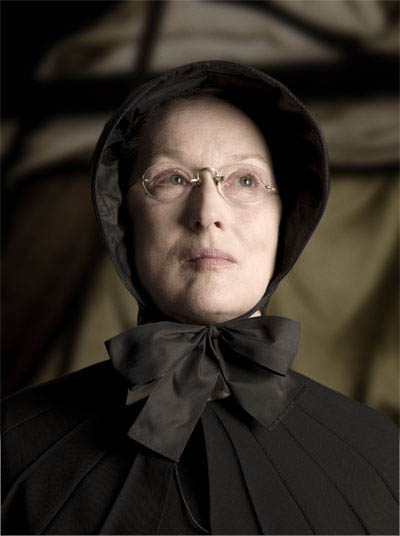
The script wouldn’t have worked, however, if it were not for the performances. Oh, the performances. What a glorious cast! Meryl Streep is, as always, brilliant as the suspicious Sister Aloysius. Phillip Seymour Hoffman is, as always, stunning and natural as the accused Father Flynn. Amy Adams is, as always, wonderful as Sister James, the one caught in the middle of the two. All three of them were nominated for Oscars for their performances here, as was Viola Davis for her great but brief role as the boy’s mother.
I don’t only love the film for its script and acting, though. I love it for its ambiguousness. At the end of the film, we are never told whether Father Flynn committed the evil acts he has been accused of or not. We are left with a broken sister Aloysius crying on the shoulder of Sister James, questioning her own suspicions. Was Flynn guilty? Was Aloysius right to accuse him? Was she right to destroy his life and have him removed from the parish? We don’t know. We must decide for ourselves.
DOUBT : A-
Subscribe to:
Posts (Atom)


