Monday, June 8, 2009

Wendy & Lucy


Wendy and Lucy is American neo-realist filmmaker Kelly Reichardt’s latest addition to the movement, and her follow up to the acclaimed Old Joy. Wendy and Lucy stars Michelle Williams as Wendy Carroll, a young woman traveling to Alaska in search of work. Her only companion is her dog Lucy. Wendy faces challenges along the way (lack of money, broken car, etc.), but the worst of her setbacks is the loss of Lucy, who disappears somewhere along their journey.

Lucy’s disappearance is the main point of the purposefully simple plot. The film is not plot-driven; it’s a character film that’s really about the infinite search for the American dream.

Michelle Williams is amazing as Wendy. Her performance was one of last year’s best: naturalistic, youthful. She’s an easy actress to fall in love with.

Wendy and Lucy is, like Old Joy, a meditative and thoughtful film. Unlike Old Joy, however, this one never really meanders. There’s always something going on. I think that with time, Wendy and Lucy will be looked back on as a key film in the American Neorealist movement.

WENDY & LUCY : B

Thursday, June 4, 2009

Doubt

**SPOILERS**

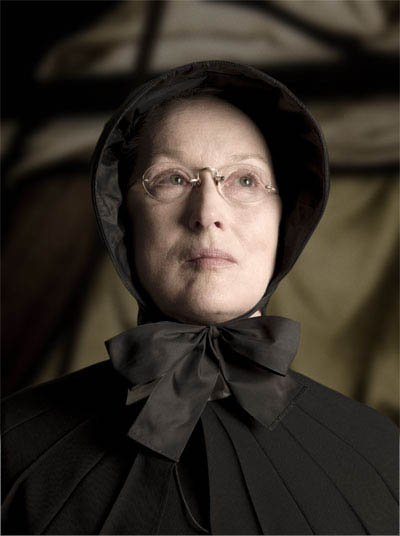
Last year’s Oscar-nominated film Doubt stars Meryl Streep as a nun who accuses a pastor (Phillip Seymour Hoffman) of molesting a child at their Catholic parish. Quite the taboo topic, and one not spoken about enough in movies. Doubt is one of last year’s most thought-provoking films. It left me thinking about it long after I left the theater.

John Patrick Shanley, the director of the film, adapted it to the screen from his own stage production. The movie, at times, feels like it would be a bit more adept for the stage, but that’s not necessarily a detrimental remark. I just mean that its dialogue drives it. At last year’s Oscars, it was nominated for Best Adapted Screenplay. I think it should’ve won.


The script wouldn’t have worked, however, if it were not for the performances. Oh, the performances. What a glorious cast! Meryl Streep is, as always, brilliant as the suspicious Sister Aloysius. Phillip Seymour Hoffman is, as always, stunning and natural as the accused Father Flynn. Amy Adams is, as always, wonderful as Sister James, the one caught in the middle of the two. All three of them were nominated for Oscars for their performances here, as was Viola Davis for her great but brief role as the boy’s mother.

I don’t only love the film for its script and acting, though. I love it for its ambiguousness. At the end of the film, we are never told whether Father Flynn committed the evil acts he has been accused of or not. We are left with a broken sister Aloysius crying on the shoulder of Sister James, questioning her own suspicions. Was Flynn guilty? Was Aloysius right to accuse him? Was she right to destroy his life and have him removed from the parish? We don’t know. We must decide for ourselves.

DOUBT : A-

Wednesday, May 27, 2009

Neo-Neo-Realism


I’d like to write about the milieu of current American independent cinema. Right now, a growing trend has appeared that many critics have dubbed neo-neo-realism; that is, a new film realism movement that employs many of the same techniques of the Italian neo-realism movement of the 1940’s headed by filmmakers like Vittorio De Sica, Roberto Rosselini and screenwriter/theorist Cesare Zavattini, among others. The films of this time and place, like Bicycle Thieves, Umberto D. and Open City were hugely influential.

These films were a reflection of post-World War II Italy. The poverty rate was high. Filmmakers created movies not as escapism, but as a way to reflect the times and the changes that had destroyed the Italian economy.

The first neo-realist movement has never been as influential as it is right now. Filmmakers like Ramin Bahrani and Kelly Reichardt are making films today that are basically just the next step for neorealism. Bahrani’s movies like Man Push Cart and Chop Shop (and now Goodbye Solo, which I haven’t seen but look forward to) take advantage of certain aspects of the previous movement. They use nonprofessional actors, a documentary-like visual style and conversational dialogue. Kelly Reichardt’s films, on the other hand, like Old Joy and Wendy and Lucy, are very naturalistic and political. Every single one of these films has been critically acclaimed, and much discussed on the arthouse circuit. Although Bahrani has only directed three films, Roger Ebert has already declared him one of the most important filmmakers working today.

I wanted to write about this current movement because I feel like we’re in the middle of something big happening right now. The American cinema needs a break from all the high-priced action extravaganzas. The neo-neo-realism movement (and I don’t care for that title, so I’ll dub it American neo-realism) is an answer to the politics and condition of our country. It’s been a while since American cinema has faced a new wave of change this swift. I think it’s just what we need.

Friday, May 22, 2009

Top Twenty : Films of 2008

This is the final Year End Top Ten (Twenty) until the end of '09. I hope you've enjoyed reading these as much as I have making them.

2008

1. Let the Right One In
2. Milk
3. Dear Zachary : A Letter to a Son About His Father
4. Revolutionary Road
5. Slumdog Millionaire
6. Doubt
7. Wall-E
8. Happy-Go-Lucky
9. Synecdoche, New York
10. The Band’s Visit
11. In Bruges
12. Frost / Nixon
13. Forgetting Sarah Marshall
14. 4 Months, 3 Weeks and 2 Days
15. Wanted
16. Shotgun Stories
17. Gran Torino
18. The Visitor
19. Iron Man
20. Man On Wire

Angels & Demons

Ron Howard’s latest flick is an adaptation of the sequel to Dan Brown’s controversial novel The Da Vinci Code. This film, Angels and Demons, introduces us once again to the character of symbologist Robert Langdon (Tom Hanks). This time, he must uncover the mystery behind the recent resurgence of the Illuminati, an ancient group of Atheist philosophers and intellectuals who were banished and tortured by the Catholic Church many, many years ago. Now they’re back, and they’ve stolen a bomb capable of destroying Vatican City and everyone in it.

I can’t say I was a fan of the film adaptation of The Da Vinci Code. It was dull, boring and preposterous, but while Angels and Demons is definitely preposterous, it is anything but dull and boring. Ron Howard has replaced the previous film’s long, monotonous talk sequences with action scenes. When Code needed to run, it stood still. That’s not a problem here. Angels and Demons is loaded with some really nifty special effects. It’s not convoluted like its predecessor, and it’s far from boring.

The whole film, however, is supported by its performances. Ewan McGregor is great as a priest who takes over rule of the Catholic Church after the Pope’s death while they find a new, permanent Pope. Israeli actress Ayelet Zurer (who is often considered Israel’s best actress) holds her own against Tom Hanks (who is great here too, and not in enough stuff anymore).

Ron Howard is often considered by cineastes to be a mediocre director, the epitome of a journeyman who always turns in OK work, but never anything great. I’ve always defended his films. While he has had plenty of missteps in the past (like How the Grinch Stole Christmas), he has also directed A Beautiful Mind, Apollo 13 and Cinderella Man, all films that I love. Plus, let’s not forget that this is one of the guys behind the greatest TV show of all-time (you read that right) Arrested Development.

But back to the film. If Angels and Demons is any kind of a sign, this is going to be a good summer for movies.

ANGELS & DEMONS : B+

Thursday, May 21, 2009

Star Trek


I’ve been a bit skeptical of J.J. Abrams as of late. Although Lost is probably my favorite show on television right now, and I loved Cloverfield more than most people, J.J. only produces those things. Sure he co-created Lost, but he doesn’t really do much hands-on stuff with the show anymore, and Matt Reeves is the one who directed Cloverfield.

But my doubts have all but vanished with Star Trek, J.J. Abrams second foray into actual director mode. With the film, Abrams proves himself to be a man full of more than just ideas. Star Trek is a bravura piece of blockbuster filmmaking, a phaser blast to the gut of the science fiction genre. Every action scene (and there are plenty) is thrilling, every shot bright and inventive and every line of dialogue delivered with the perfect blend of Shatner-era nostalgia and modern sarcastic wit.

The film looks flashy and bright. Vivid streams of light cross each scene. The special effects are among the best I’ve seen. The Enterprise looks at once sleek and modern, yet instantly recognizable (a great metaphor the film itself). The film is ingeniously cast. Zachary Quinto is especially notable for his performance as Spock. He’s as brash and confident as you could imagine a young Spock would be.

When the Romulan Nero, who killed Kirk’s father, confronts the Enterprise and takes its captain hostage, Kirk, Spock and everyone else go on a mission to rescue him. The film, a prequel to the original series, concerns the assemblage of the crew we all know and love. It describes the manner of how they all became a part of the Enterprise. It’s a very human story. Everyone’s motives are made clear; Kirk wants to avenge his father’s death and Spock wants to prove that a half-Vulcan, half-human like himself is capable of accomplishing all that a full-blooded Vulcan can.

As you’ve probably heard, Star Trek has something to appeal to Trekkies (Trekkers?) and casual fans alike. Don’t miss out on this one.

STAR TREK : A-

Tuesday, May 19, 2009

Top Twenty : Films of 2007

2007 was a particularly great year for films, so I decided to start making top twenties instead of just top tens from this year forward.


1. No Country for Old Men
2. Once
3. Before the Devil Knows You’re Dead
4. I’m Not There
5. The Assassination of Jesse James by the Coward Robert Ford
6. Michael Clayton
7. No End In Sight
8. Into the Wild
9. Zodiac
10. Starting Out in the Evening
11. There Will Be Blood
12. Ratatouille
13. The Savages
14. Paprika
15. Inland Empire
16. Sicko
17. Away From Her
18. Control
19. Black Book
20. Atonement